This Week's Wisdom at a Glance:
|
Wisdom for Life
In the esteemed 1996 film Space Jam, Bill Murray says to Michael Jordan and Bugs Bunny:
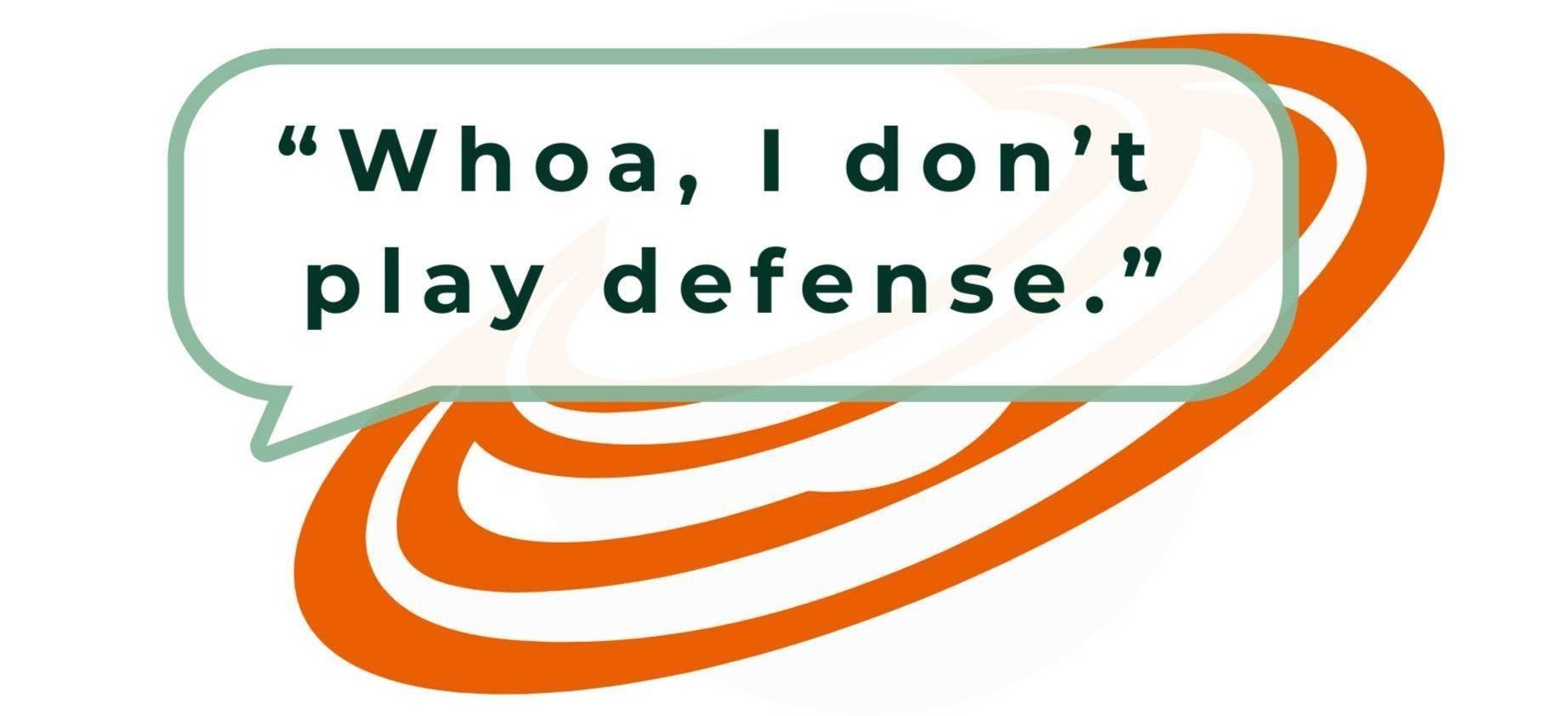
While that may have been true for Bill in the bizarre half animated - half real world depicted in the movie, it is not true for how your money is being managed! (As an aside, if you don’t know that movie reference, I must warn you it received a 46% on Rotten Tomatoes. Probably fair, but it was still a favorite of mine growing up.)
Below are four examples of how we play defense for our clients:
We repeat this often, but it is because it is that important: a properly funded cash reserve is the best defense you can play with financial planning. Surprise expenses happen in life, and you need to have quick access to cash in order to pay for those expenses.
Insurance. This includes proper home & auto insurance, umbrella liability coverage, life insurance coverage (particularly if you have dependents), disability coverage, and depending on your situation, long-term care coverage.

Asset allocation. This term can have multiple meanings, but in this context I’m referring to the breakdown between how much of your investments are in equities (stocks) vs. fixed income (bonds).
The reason to hold fixed income (vs. entirely owning equities) is that bonds pay us a steady rate of income, and should have significantly less volatility than equities over most time periods. So, if you have needs for your money that are in the next 1-6 years, there is a good argument to be made that the portion that is needed should be invested in fixed income instead of equities.
Diversification in equities. There are many ways that we pursue diversification with our equity holdings. One avenue is to hold a broad range of industries and sectors across the economy, as these various components of the broader equity market can perform much better than others during different market conditions.
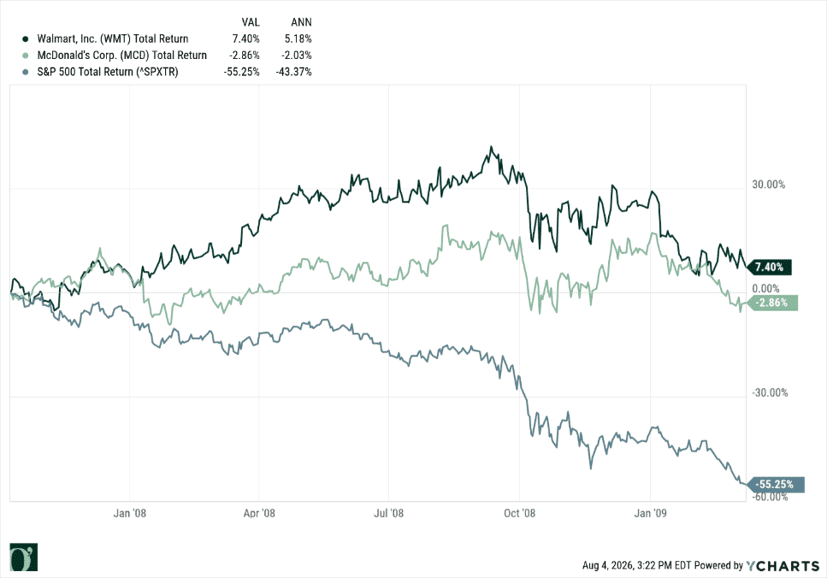
One example of this: during the Great Financial Crisis (2007 – 2009), both Walmart and McDonalds fared much better than the rest of the equity market. One simple reason: during a time of extreme economic upheaval, people made sure that their dollar went as far as possible by getting household essentials at Walmart and they ate on a budget at McDonald’s.

The chart below shows the time period from October 9, 2007 (the beginning of the market downturn during the Great Financial Crisis) until March 9, 2009, which was the low point for the S&P 500 during this time period.
Walmart was up almost 8% over this time frame, McDonald’s was down a little less than 3%, and the S&P 500 was down 55%.
The lesson: if you own every industry and sector (across geographies), you can have exposure to companies that fare better during market stress. This is also designed to allow you to recover more quickly from downturns compared to being more concentrated in a particular company or sector.
We spend plenty of time with clients talking about offense, too: growth, opportunity, taking calculated risk. But defense is what lets you stay in the game long enough to play offense at all. There’s a time to play offense with your financial plan and there is a time to play defense. It’s vital to have both in your toolkit.
Thanks for reading,

Jack O'Connor, CFP®