This Week's Wisdom at a Glance
THERE ARE MEANINGFUL REASONS TO REMAIN FINANCIALLY OPTIMISTIC ABOUT THE FUTURE
Reasons to be Optimistic
Inflation is higher than we’d like.
There’s armed conflict in the Middle East.
There’s unprecedented political upheaval in the United States.
New technology is upending how people work.
Interest rates are making it harder to buy a home.
Are these statements referring to the 1970’s, or to 2026?
Trick question.
These statements could apply to either time period. The point is twofold:
There will always be legitimate concerns (both economic and otherwise) about the world.
To this point, however, humans have been remarkably resilient and clever to navigate innumerable challenges to overcome many of the obstacles that have faced society.
Are things perfect today? OF COURSE NOT.
But we believe it is better to live with a glass half full mentality, so below are 5 reasons to be optimistic (from a financial perspective):
1. Economic Output is Increasing
Adjusted for inflation, the United States produced $32,064 of economic output per person in 1980. In early 2026, the figure grew to $70,515 per person. That’s 2.2 times higher over the last 46 years.
Put another way, on a per-person basis, the United States economy is substantially more productive than it was in 1980.
Source: Bureau of Labor Statistics, Federal Reserve Bank of St. Louis.

2. Global Poverty Has Collapsed
In the early 1980’s, the World Bank estimated that over 40% of the world’s population was living in extreme poverty. Today, estimates are that less than 10% of the world’s population lives in extreme poverty. That’s an incredible reduction.
Source: World Bank, Poverty and Inequality Platform, as compiled by Our World in Data.

Percentage of the worldwide population living in extreme poverty according to World Bank
3. Generosity is Growing
Charitable giving in the United States exceeded $600 billion for the first time in 2025, and adjusted for inflation, 2025 was the second highest year for charitable giving ever, behind 2021.
Here’s to hoping that these charitable dollars improve the quality of life for people across all demographics and walks of life.
Source: The Annual Report on Philanthropy for the Year 2025, Giving USA Foundation, researched and written by the Indiana University Lilly Family School of Philanthropy
4. Energy Independence
While the global energy market has innumerable complexities (politically, economically, socially, scientifically, etc.), what remains in 2026 is that every country in the world is completely dependent on large amounts of energy to power their economy. (this energy of course can come from both renewable and non-renewable sources).

As Michael Cembalest points out in his June 2026 publication of Eye on the Market, the United States is one of only a very small handful of countries globally that is entirely self sufficient for energy needs. By contrast, he notes that some developed countries require more than 90% of their energy needs to come from external sources.
Source: JP Morgan Guide to the Markets, June 2026
5. Technology is Enabling Entrepreneurship
Starting a business has never been more accessible. According to the U.S. Census Bureau, Americans filed 5.62 million new business applications in 2025, which was an all-time high, and nearly double the pre-pandemic annual average. Tools like cloud computing, e-commerce platforms, and now artificial intelligence have dramatically lowered the cost and complexity of launching a venture, putting entrepreneurship within reach of more people than ever before.
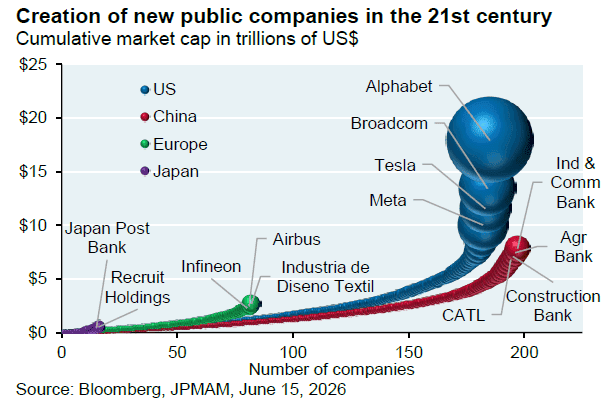
Michael Cembalest highlighted this trend in his June 2026 J.P. Morgan Eye on the Market piece, showing that in the 21st century, the United States has created dramatically more value through new public companies than China, Europe, or Japan combined, which reinforces that the U.S. remains the world's most fertile ground for turning new ventures into lasting enterprises.
Source: U.S. Census Bureau, Business Formation Statistics, J.P. Morgan Eye on the Market, "Semiquincententacles," June 2026
Thanks for reading,

Jack O'Connor, CFP®